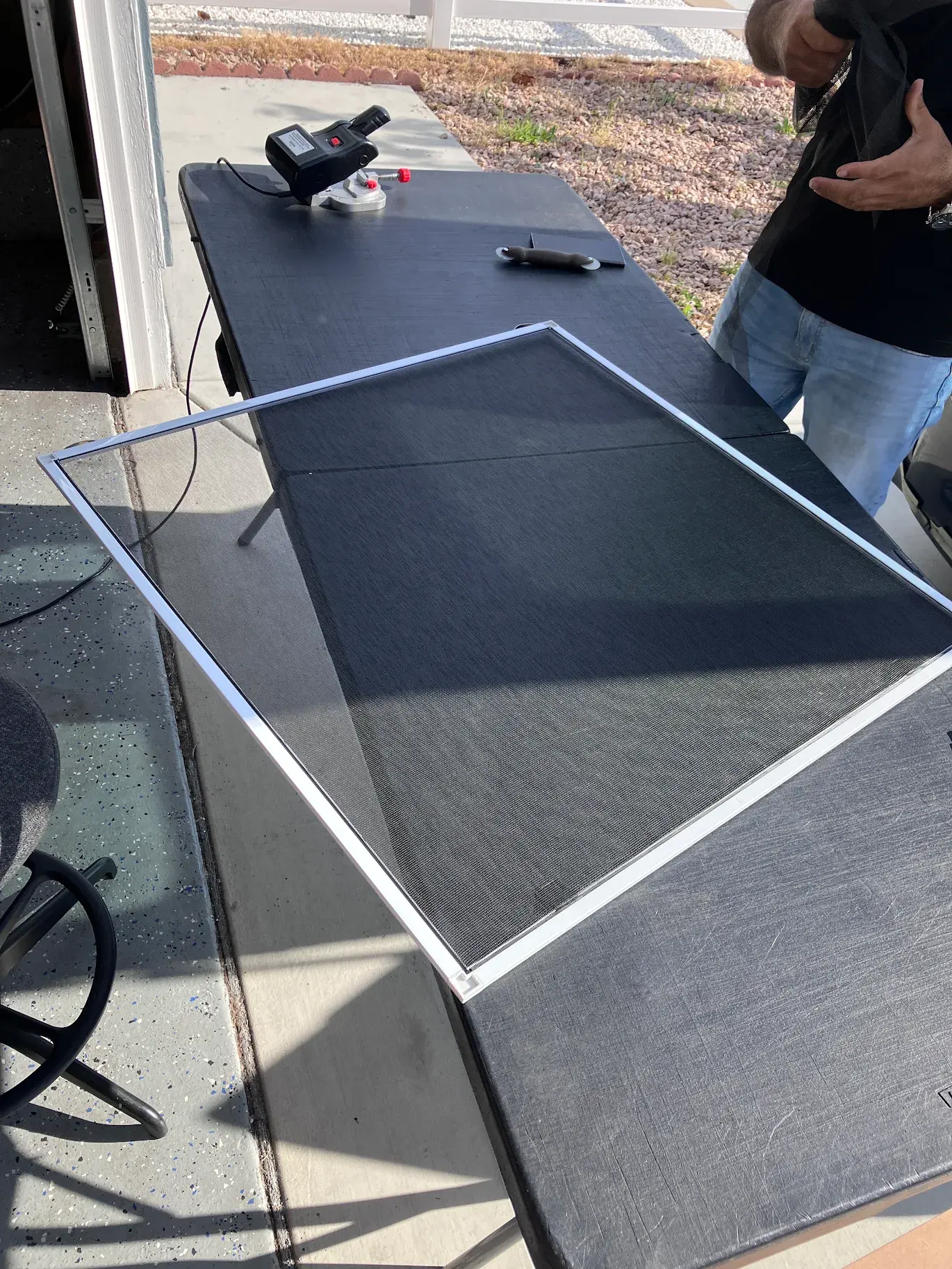
Type "how to measure window screens" into any search engine and you'll find a dozen guides, each slightly contradicting the last. Measure the frame. No — measure the opening. Deduct an eighth of an inch. No, a quarter. It's enough to make anyone give up and live with the torn screen for another summer.
Here's the honest version, from a crew that has measured a few thousand of them — followed by the part most guides won't tell you: for a professional visit, you don't need to measure anything at all.
If you're measuring for a DIY replacement
The cardinal rule: measure the old screen frame, not the window. The screen sits in a channel that's slightly bigger than the frame itself, and the frame — not the glass, not the opening — is the thing your replacement must match. Pop the old screen out (push the springs on one side, tilt, lift) and lay it flat.
- Width: measure edge to edge across the frame at the top, middle and bottom. Old frames rack out of square; use the smallest number.
- Height: same idea, left side, middle, right side. Smallest number wins again.
- Thickness: most residential frames are 5/16" or 7/16". Get this wrong and the new screen either rattles or won't seat.
- Hardware: note where the springs, pull tabs and corner clips sit. Photograph everything before you order.
Where DIY orders go wrong is rarely the tape measure — it's the assumptions. Screens that "look standard" turn out to be 1/4" narrower on one side because the house settled in 1987. Two windows that look identical from the lawn differ by half an inch. And if the frame itself is bent or the corners have failed, a perfectly measured new mesh solves nothing — that frame needs replacing, which is a different project (our guide to rescreen vs. replace covers how to tell).
The measurement that actually matters to us: none
When you request a quote from Golden Screen Services, we ask for exactly one thing: eyeball it. Count your screens, tell us roughly what they are — windows, sliding doors, anything unusually large — and your city. That's genuinely the whole assignment.
We can price a job from that because our pricing is flat per unit: rescreening is $45 per window, a new custom screen is $65, a sliding door is $99 — whatever size your windows turn out to be. The precision measuring happens at your home, on our side of the job, where it belongs. Every screen we build is measured against its actual opening and fabricated on the spot, which is also why fit problems essentially don't happen — and why we can afford a fit-right guarantee that says if it doesn't fit perfectly, we come back and make it right.
When a photo helps
A phone photo is worth sending if something about the screen looks unusual: an arched top, a half-round, a screen wider than a doorway, or hardware you don't recognize. Text one over and we'll tell you on the spot whether it's standard pricing or needs a custom quote. That's still not measuring — that's pointing your phone at a window.
So: if you enjoy DIY, measure the frame three times, use the smallest numbers, and order carefully. If you'd rather spend those two hours differently, the one-minute quote form plus an eyeball count gets you a firm price — and in San Diego, often a same-week visit.