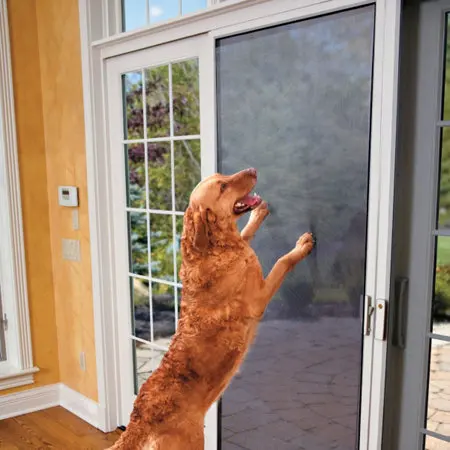
Every screen crew has a version of this customer: same house, same sliding door, third mesh replacement in two years. The dog is never sorry. The mesh is always standard fiberglass. And the math has quietly stopped working in the homeowner's favor.
This is the job pet screen exists for — and it's one of the few upgrades in our trade that's honestly transformative rather than incremental.
What standard mesh is, and why pets defeat it
Standard insect mesh is fiberglass yarn coated in vinyl, woven light so it stays nearly invisible and cheap. It's a great material for its actual job — stopping bugs and letting air move — but structurally it's a fabric of thin threads under tension. A dog's paw strike concentrates force onto a few of those threads; they stretch, then pop, and a hole starts. Cats are subtler and worse: claws hook single strands, and a climbing cat unzips a screen like a seam ripper.
What pet screen is
Pet-resistant screen — TuffScreen is the name we install — is vinyl-coated polyester, woven from strands several times thicker than standard fiberglass. The finished fabric is roughly seven times stronger than standard mesh. In practice, that means a paw strike bounces instead of punching through, claws can't hook individual strands, and the mesh holds its tension instead of bagging out where the dog leans on it every afternoon.
The trade-offs are small and worth naming honestly: pet screen is slightly heavier visually — you can see the weave if you look for it — and it costs more than standard mesh. Airflow and visibility remain close to normal; from a few feet back, most guests can't tell.
The math
A standard sliding door rescreen runs $99; the pet screen version is $120 booked online. If your mesh fails from ordinary sun and age every eight or ten years, standard is the right buy and the $21 difference buys you nothing. But if an animal has taken out the same door twice, you're not choosing between $99 and $120 — you're choosing between $120 once and $99 on repeat. One of our Google reviewers put it best after a technician suggested the upgrade: heavier dog-proof netting "to save on replacement cost… which I thought was very informative." That's the whole pitch, from a customer.
Beyond the sliding door
The same mesh drops into ordinary window frames, which matters for cat households — a window a cat perches against or climbs is a standard-mesh casualty waiting to happen. We also install screen-mounted doggie doors in sliding screen doors, so the dog stops treating the mesh itself as the exit.
If your household includes anything with claws, tell us when you get your quote — we'll tell you honestly which openings justify the upgrade and which are fine in standard mesh. It's a popular call in the big-dog suburbs of Orange County and everywhere else we work.