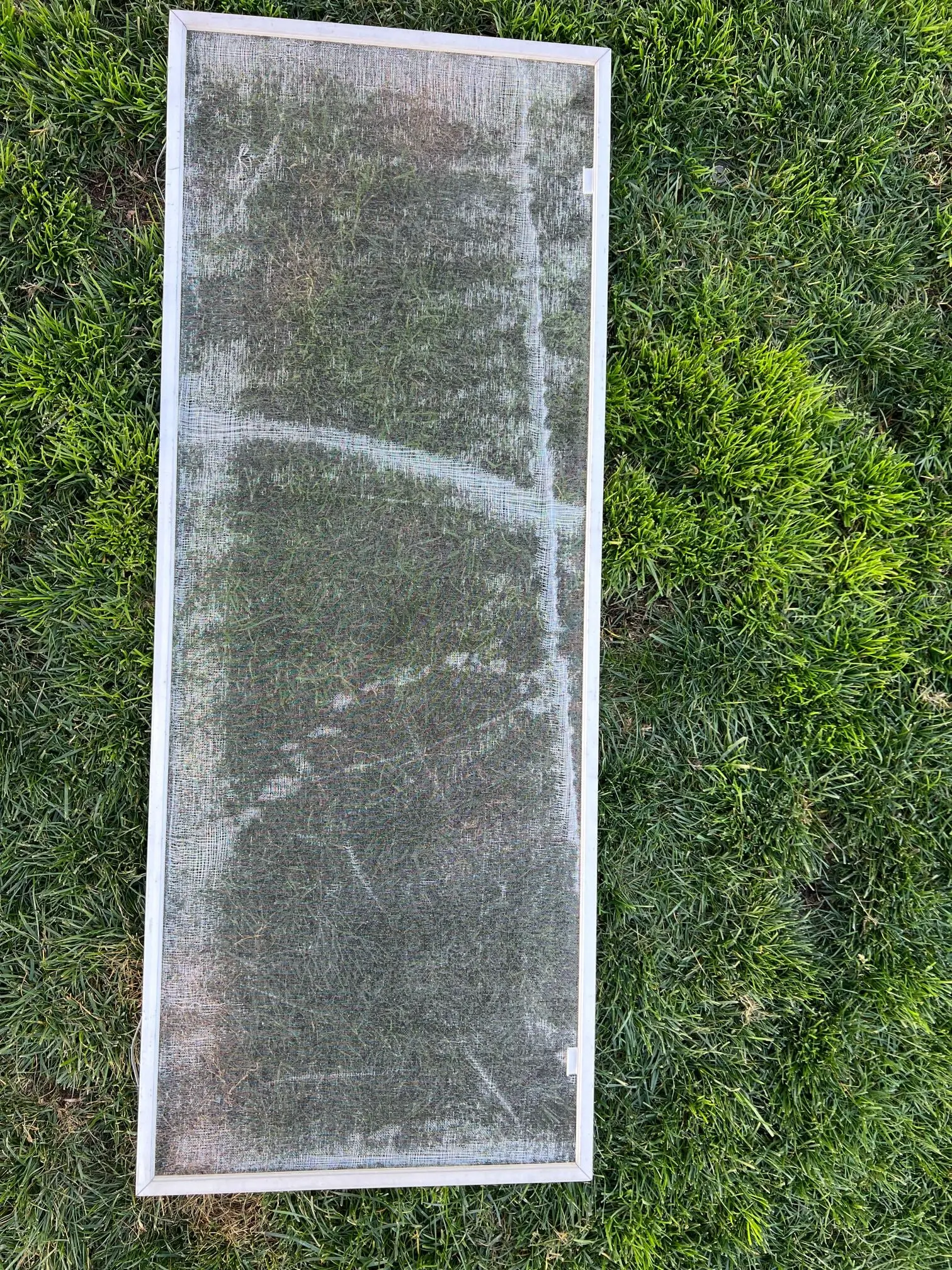
Pull a twenty-year-old screen off a California window and it tells you its whole biography. Chalky grey where it used to be charcoal. Brittle enough to crack when you flex it. Sagging in the middle like a tired trampoline, and split along the sun-facing edge. None of that is bad luck — it's chemistry, and it runs on schedule.
What the sun actually does to mesh
Standard screen mesh is fiberglass thread with a vinyl (PVC) coating. Ultraviolet light attacks the vinyl directly, breaking the polymer chains that keep it flexible — the same process that fades and cracks a dashboard. As the coating degrades it loses its plasticizers, turns chalky, and shrinks its grip on the glass fibers beneath. The fibers themselves then fray at every flex point. That's why old mesh looks grey (chalked vinyl), feels stiff (lost plasticizer), and tears at a touch (exposed fiberglass with no jacket).
Heat piles on. Mesh expands in the afternoon and contracts at night, thousands of cycles a year, which is where sag comes from — the fabric stretches at its fixing points and never quite returns. A south- or west-facing screen in inland California lives this cycle at maximum intensity, which is why the screens on one side of a house routinely die years before their siblings around the corner. Add salt air on the coast (it corrodes the spline channel and accelerates coating breakdown) and Santa Ana winds flexing the whole panel in its frame, and a realistic service life for standard mesh in our climate is eight to twelve years — less on the hot faces.
The good news: the frame usually survives
Everything above happens to the mesh. The aluminum frame around it is largely indifferent to UV and typically outlives its mesh several times over. This is the most useful fact in the whole subject, because it means most "my screens are ruined" situations are actually $45 rescreens, not full replacements: same frame, corners repaired, fresh Phifer or BetterVue mesh splined in tight, ten to fifteen minutes per window on our on-site work table.
The exceptions are frames that are bent, cracked at the corners, or racked out of square — usually from being forced, dropped or pried rather than from weather. Those need a new custom-built screen ($65). If you're not sure which side of the line yours are on, our rescreen-or-replace checklist walks through it, or just let us look — we'll tell you on sight, and we don't sell frames to people who don't need them.
Slowing the clock
- An occasional gentle rinse keeps chalk and grit from grinding the coating at every breeze.
- On brutal west faces, consider solar mesh — its heavier build tolerates sun better while cutting the heat load on the room behind it.
- Don't leave screens leaning against a sunny wall for the winter; the side facing out ages at double speed.
And when a whole side of the house has gone grey at once — which is exactly how UV failure presents — that's the moment batch pricing makes sense. Twenty screens is an afternoon for us, whether you're in San Diego or on our weekly Los Angeles route. Eyeball the count, send the form, done.